By Igor Rodrigues Ramos – 2 March 2026
Translated by Iago Molist
Published on jvmag.ch (French‑speaking Switzerland): https://jvmag.ch/2026/03/02/shenmue-ou-lapprentissage-dune-vie-rencontre-avec-antony-fournier/
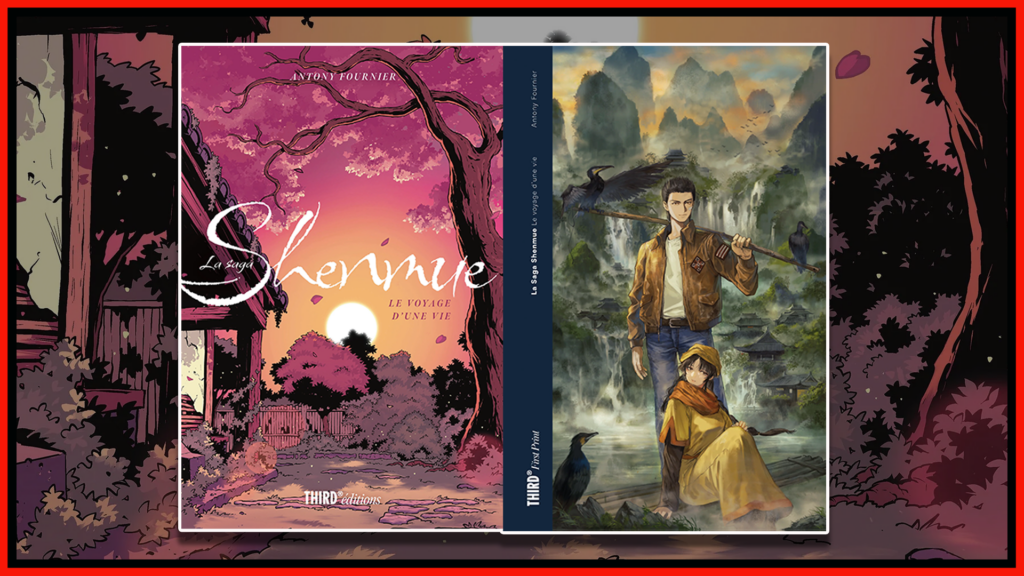
On the occasion of the release of his book dedicated to Shenmue published by Third Editions, La saga Shenmue, le voyage d’une vie (The Shenmue Saga: The Journey of a Lifetime), I had the opportunity to ask a few questions to Antony Fournier, a passionate author and specialist in Japanese video games.
Now 37 years old, he has been playing and writing for as long as he can remember, at least fictional stories (although none has been published to date). His first reviews—mainly dedicated to cinema and video games—date back to around 2006, when he was still in high school. He contributed to several more or less professional websites—most of which no longer exist today—before moving from blog to blog. It was ultimately his meeting with Third Editions in 2020 that gave him the opportunity to write his first book.
After authoring works dedicated to Suda51 and Hideo Kojima, he continues his exploration of major figures of the medium with a book dedicated to the cult work imagined by Yu Suzuki. He looks back with us on his career, his working method, and his personal relationship with Shenmue.
Your latest book published by Third Editions is dedicated to the Shenmue saga. How do you approach writing a book about such a legendary work?
The most complex aspect in my view—or at least the first issue I asked myself—was precisely what gives Shenmue its legendary status. How do you approach a subject that already carries such a cult following, about which it seems everything has already been said, analysed, and explored? It was from that question that I began my research, gradually shaping the angle not around what might already have been said or what might still remain to be said, but above all around the subjects and themes of Shenmue that genuinely resonated with me.
How this franchise—which I have loved since its release and which affected me so deeply—is rooted in a stream of reflections and ideas, driven by influences that are not only very real and concrete, but also somewhat neglected today and within our medium: legends originating in China, Taoism, martial arts viewed from a philosophical rather than purely practical perspective; the idea of experiencing each moment of everyday life at one’s own pace rather than submitting to that of our environment.
But Shenmue is not only that. It is also a design philosophy, a technological feat that was revolutionary at the time.
It is a work that represents the ideas of Yu Suzuki, not only as a game creator, but also as a human being. It was with these ideas in mind—with the intention of telling, in a book, how Shenmue is a title driven as much by technological challenge as by its need to represent reality, the energy of life in its purest form—that I was able to define the angle of this book more clearly.
Is there an aspect of Shenmue that you rediscovered or understood differently while working on it?
Understood differently, I don’t think so. Deepened and rediscovered, on the other hand—very clearly, yes.
In the same way that working on the work of Goichi Suda for my second book reminded me of many things I loved in the past and had forgotten or set aside as I grew older—creative ideas, inspirations about the very meaning of creating freely—working on Shenmue above all brought me back to my affection for martial arts and their philosophy, their history, and their richness, and what they can offer positively in daily practice.
Rediscovering that part of myself at the same time as rediscovering Shenmue, after so many years and in a more sustained way (since I was playing it with the aim of writing about it rather than simply replaying it), also led me to reflect on my own life experience and, in some ways, brought me certain answers—spiritually speaking. It was soothing and a very beneficial form of remembrance.
If Shenmue were truly “the journey of a lifetime,” what does it represent for you personally today?
Shenmue represents, in my eyes, an idea I have supported for a long time: continuous learning. We learn throughout life; we continue to discover and deepen our understanding from birth to our final breath.
Shenmue embodies this notion of learning and self‑development through Ryo’s journey, which—precisely because it has never had an ending to this day—illustrates this idea. But also because Shenmue, as a work, is an inexhaustible source of inspiration.
I discovered it in 1999, when I was only ten or eleven years old, and replaying it throughout my life has always taught me something new—something I hadn’t noticed before.
Shenmue is a journey: that of its hero, that of its characters, that of all these lives that intertwine and come into conflict or harmony with the world. But for a very large part of its audience and its fans, Shenmue is also, quite literally, a journey that for 25 years has continued to influence their lives to some degree.
That is something which, for better or worse, is now inseparable from the franchise and very present in Shenmue III: the impact of the work on its audience, and how that audience continues today to keep it alive and pass it on.
If you had to summarise Shenmue in a single sentence after writing this book, what would it be?
“The story goes on”. Not only that of Shenmue, but that of everyone—its audience, Yu Suzuki, and the world in general.
After writing about Suda51, Kojima, and Yu Suzuki, do you feel you are tracing a common thread around Japanese video game authors? Was this intentional?
It wasn’t really intentional, in the sense that it was Third Editions who proposed these topics to me each time. But it turns out those proposals were well chosen, since these are indeed three of my favourite game creators, and among those who have most profoundly influenced me throughout my life—whether in terms of reflection, philosophy, art, culture, or even ideas and sensitivities in game design.
I don’t know if we can really speak of a “common thread,” but I do feel a form of continuity between my three books. These are three creators who, each in their own way, with their respective tools and works, transformed the industry, revolutionized genres, or quite literally laid their foundations.
Creators who sometimes crossed paths, but who each have their own sensibilities, strengths, and favoured subjects; who are all “almost” from the same generation, but with enough age difference to have distinct influences, horizons, and visions of their medium.
It is a common thread in that sense—and you are therefore right to name it as such—that I would like to continue extending further within Japanese video games, exploring lesser‑known or older creators, or on the contrary younger ones who openly claim the influence of these three monuments of the medium.
How did your collaboration with Third Editions begin? Was it a personal initiative or an editorial encounter?
To be honest, I never imagined I would be able to write a book of this kind—let alone three. I had even moved away from writing somewhat, due to a lack of time and energy.
So, they were the ones who contacted me first (after reading, I believe, a review I had written of Metal Gear Solid V: The Phantom Pain, among others) to propose that I write about Death Stranding. I had just finished the game at the time, give or take a few weeks, and the very idea of writing anything about it hadn’t even crossed my mind.
But it was the kind of proposal that would have haunted me for the rest of my life had I refused it, so I accepted without hesitation.
Is there a creator or a work you dream of analysing next?
More than one! I would love to continue immersing myself in the history of video games—not necessarily Japanese, but niche or lesser‑known, yet essential to the medium’s history.
For example, working on creators such as Kenji Eno (D, Enemy Zero), Kazutoshi Iida (Doshin the Giant); people like Keita Takahashi, Kazuma Kujo, Kaz Ayabe, or the entire Love‑de‑Lic team that gave birth to Moon: Remix RPG Adventure, and later games like Chulip, Endonesia, Captain Rainbow, Rule of Rose, and more recently Stray Children.
As for specific works, I would like to take the time to focus on subjects such as Pikmin, Animal Crossing, or Ganbare Goemon—franchises that may not be as dense or profound as Shenmue or Metal Gear, but which nonetheless deserve to be told and analysed just as much.
Beyond Japan, Western franchises like Hitman, Mafia, or Oddworld interest me just as much… In short, subjects and ideas are not lacking! Time and resources, on the other hand…
What are you playing at the moment?
Romeo Is a Dead Man at the moment I’m writing these lines—the latest game from Grasshopper Manufacture / Suda51—and it’s quite fantastic. I’ve also started Cairn, which I find very exhilarating, and Relooted, which I’m eager to explore further.
As for older games, Shenmue is still more or less running—at least to revisit the three games one last time now that the book has been released, before setting them aside for a longer while.
And there are always my “bedside games,” the ones I can launch on a whim at almost any time: Virtua Fighter, Crazy Taxi, Fading Afternoon, etc.
A final word?
“In the end, what matters most is people”. This is one of the ideas expressed by Yu Suzuki when he returned from China during his early travels. It is also an idea that is personally close to my heart.
Listening to people, enriching ourselves through others’ experiences—through their stories, testimonies, or creations, whatever the medium—is ultimately what helps us grow, learn, and better understand ourselves.
Third Editions Website: https://www.thirdeditions.com/
To order the book: https://www.thirdeditions.com/products/la-saga-shenmue-le-voyage-dune-vie
All the books by Antony Fournier with Third Editions: https://www.thirdeditions.com/pages/auteurs/antony-fournier
Linktree of the author: https://linktr.ee/Neights_Sham