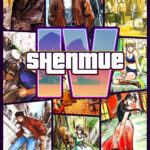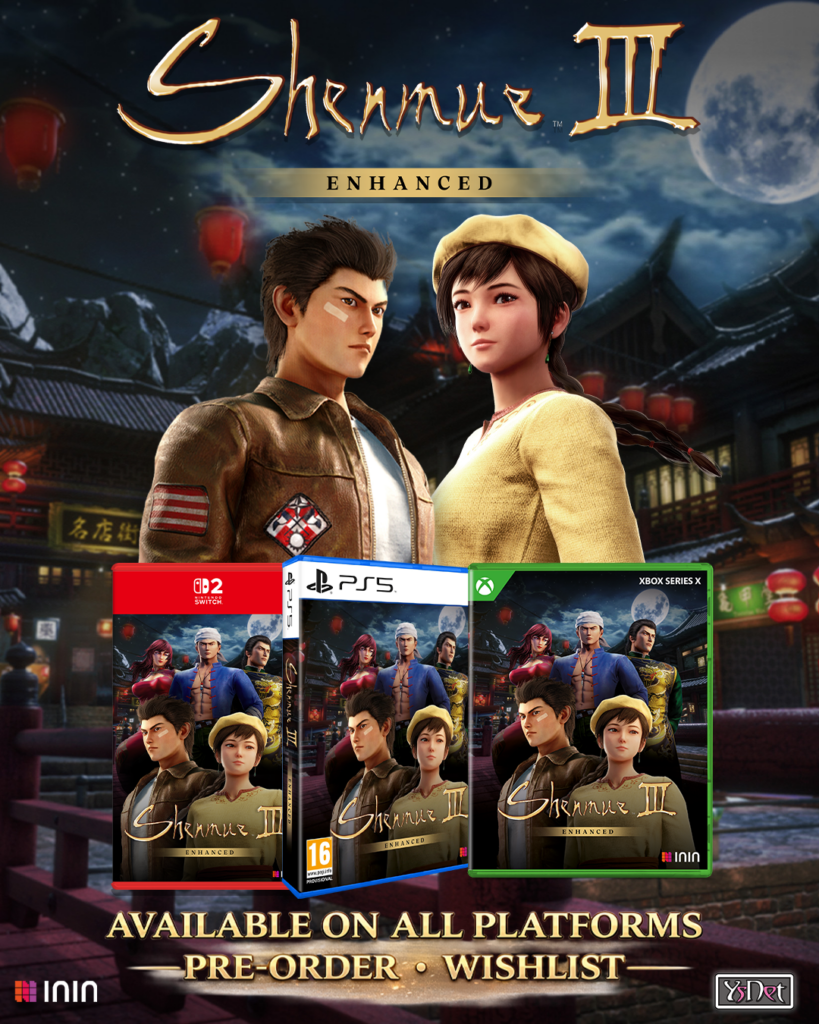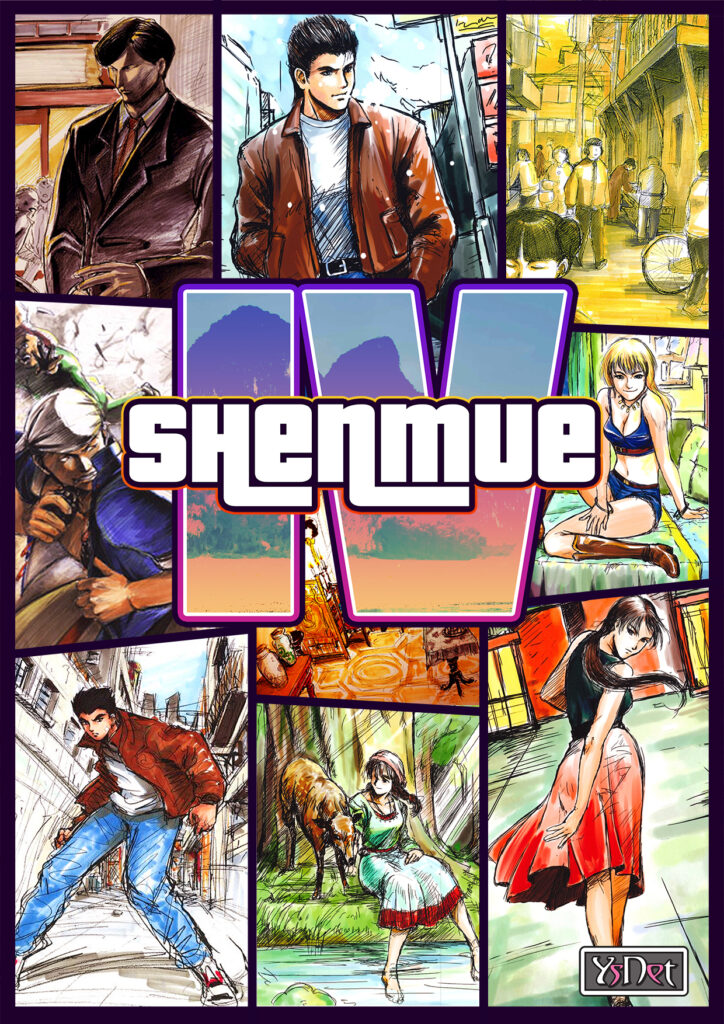
From fixing household steps and painting walls to living NPCs and everyday routines, GTA VI is drawing some surprising comparisons to Yu Suzuki’s Dreamcast classic. More than 25 years later, is the wider gaming world finally recognising what made Shenmue so revolutionary?
With the long-awaited release of Grand Theft Auto VI on 19 November 2026 (7 years to the day after the release of Shenmue 3), the gaming world has been getting to grips with Rockstar Games’ latest open-world blockbuster. While much of the attention has understandably focused on its incredible visuals, enormous world and cinematic storytelling, something rather unexpected has been happening across social media. Players have begun comparing GTA VI to Shenmue.
Yes, Shenmue.
In fact, the comparisons have become prominent enough to attract the attention of GamesRadar, which published an article highlighting how Rockstar’s dedication to simulating everyday life is reminding players of Yu Suzuki’s groundbreaking Dreamcast adventure. For Shenmue fans, the similarities are fascinating. Not necessarily because GTA VI is directly borrowing individual mechanics from Shenmue, but because the underlying design philosophy feels remarkably familiar.
Create a believable world. Fill it with people who have lives of their own. Give players meaningful interactions with their surroundings. And, perhaps most importantly, allow them to experience ordinary life rather than simply rush between missions. Sound familiar?
A Day’s Work: From Forklift Driving to DIY
One of the more amusing comparisons emerging from GTA VI concerns the seemingly mundane activities players are finding themselves undertaking.Early in the game, protagonist Jason is tasked with repairing his home ahead of Lucia’s return. Rather than simply presenting this as a cutscene, Rockstar allows players to get involved.
These activities include repairing damaged steps, fixing a leaking roof, repairing and painting a wall, and replacing damaged railings. Interestingly, these aren’t simply decorative distractions. Completing the home improvements can positively influence Jason’s relationship with Lucia, adding another layer of purpose to otherwise ordinary activities. For Shenmue fans, this particular approach should immediately ring a bell. Back in 1999, Shenmue was challenging players to undertake tasks that other video games would barely have considered worth including.
Ryo Hazuki could spend his hard-earned money purchasing capsule toys, visit convenience stores, play arcade games, purchase drinks from vending machines and investigate the contents of practically every drawer in the Hazuki residence. And, of course, there was the legendary forklift job at Yokosuka Harbour. What could easily have been a throwaway sequence became one of Shenmue’s most memorable gameplay experiences. Ryo would report for work, move cargo between warehouses, earn wages and participate in the occasional forklift race. Shenmue II would continue this philosophy with crate carrying, Lucky Hit stands and various other ways for Ryo to earn money. These activities weren’t always glamorous, but that was precisely the point.
They helped establish the idea that the protagonist existed within a functioning world, rather than one that revolved entirely around the player’s next objective. There is an important distinction: GTA VI’s opening DIY tasks are primarily story-related activities, whereas Shenmue’s forklift work was a recurring job integrated into Ryo’s daily life. Nevertheless, the shared philosophy is unmistakable. Sometimes, making a virtual world feel real means giving players something wonderfully ordinary to do.
NPC Routines: The World Doesn’t Revolve Around You
Perhaps the strongest comparison between GTA VI and Shenmue lies in their approaches to non-playable characters. When Shenmue arrived on the Dreamcast, one of its most revolutionary achievements was its simulation of everyday life. The residents of Yokosuka weren’t simply characters standing around waiting for Ryo to approach them. They had routines.
Shopkeepers opened and closed their businesses at particular times. Residents travelled through neighbourhoods, went about their daily activities and could be encountered in different locations depending on the time of day. If Ryo needed to speak to someone, they weren’t necessarily going to be conveniently waiting in one spot. Sometimes you had to find them. Sometimes you had to wait.
It sounds remarkably simple today, but this level of attention to detail was extraordinary in 1999. GTA VI is taking its own approach to populating a believable world, building upon the impressive NPC interaction systems Rockstar developed for Red Dead Redemption 2.
Players can engage with pedestrians in different ways, while the characters themselves react to their surroundings and the player’s behaviour. Rockstar has also developed an extensive system of ambient encounters. Some characters can be encountered repeatedly, with new conversations and interactions developing over time. Certain events change depending on when or how players encounter them, while others only appear under particular circumstances.
This represents a considerable evolution in open-world interaction. There are differences, of course. Shenmue’s smaller, carefully constructed neighbourhoods allowed for an unusually personal approach to named residents and their individual schedules, whereas GTA VI operates on an enormously larger scale. But both games demonstrate a shared understanding of something fundamental: A believable game world isn’t just about how many people occupy its streets. It’s about making those people feel like they belong there.
World Building: From Dobuita to Vice City
Shenmue’s greatest achievement arguably wasn’t its combat, cinematics or even its technological ambition. It was Yokosuka itself. For many fans, Dobuita Street became somewhere more than a location within a video game. It became a place they knew.
Players could recognise familiar shopfronts, remember where particular characters worked, and gradually develop an understanding of the environment through repeated exploration. The changing weather, passing time, background conversations and environmental details all contributed to that remarkable atmosphere. Yu Suzuki’s vision was about creating an authentic sense of place. GTA VI is attempting something comparable through its enormous recreation of Vice City and the wider state of Leonida.
Rather than simply constructing a large map filled with objectives, Rockstar has invested heavily in the behaviour, culture and personality of its virtual environment. The streets are packed with individual interactions, local activities and environmental storytelling. The world appears designed to reward players who slow down, observe their surroundings and explore beyond the next mission marker.
It’s a philosophy that Shenmue fans will recognise immediately. The two games are vastly different in their scale and tone, but they share an important quality. Their environments are not simply backgrounds for the action. The world itself is one of the main attractions.
The Importance of Doing Nothing
Perhaps one of Shenmue’s most enduring qualities is its willingness to let players spend time doing very little.
You could spend an afternoon feeding the kitten, practicing martial arts in a car park, playing Space Harrier or wandering through Dobuita without making any meaningful progress in the investigation into Iwao Hazuki’s murder. Some players found this approach slow or frustrating. For others, it was precisely what made Shenmue special. The game trusted players to find enjoyment in the experience of simply existing within its world.
While GTA VI offers considerably more opportunities for chaos, its quieter moments are generating some of the most interesting discussion. Players are discovering opportunities to exercise, eat meals, maintain relationships, explore recreational activities and interact with people outside the central criminal storyline.
These systems provide more than additional content. They establish a daily rhythm and help build an emotional connection with the game’s characters. We have seen Rockstar explore this philosophy before, particularly through the slower and more immersive elements of Red Dead Redemption 2. GTA VI appears to be pushing it further.
And it raises an interesting question. Were some of the features once criticised as unnecessary or excessively mundane in Shenmue simply ahead of their time?
Social Media Has Noticed: ‘Florida Shenmue’
The comparisons haven’t gone unnoticed across the wider gaming community.
GamesRadar highlighted several reactions from players on X and Bluesky who immediately recognised similarities between Rockstar’s latest blockbuster and Sega’s Dreamcast classic.
On X, @MachoDrag made the connection between GTA VI’s appeal and the type of player who once happily spent hours collecting Sonic capsule toys in Shenmue.
Another post from @phujoshi summed up the comparisons with the wonderfully simple observation:
“They’re calling it the Shenmue of 2026.”
Over on Bluesky, player Alex Lemley described GTA VI as effectively being a really good Shenmue game after spending several hours with it.
Meanwhile, @goomvi.online suggested that hearing people refer to GTA VI as “Florida Shenmue” had actually increased their interest in Rockstar’s new release. There’s also a wonderfully amusing historical parallel. When Shenmue launched in Japan in 1999, it attracted enormous attention for its unprecedented production costs and technological ambition.
Now, in 2026, GTA VI is similarly dominating discussions about the extraordinary resources required to create a cutting-edge open-world experience. The budgets and commercial circumstances are obviously very different, and GTA VI’s precise development costs have not been officially established. But the parallels in ambition are certainly striking.
Different Games, Similar Ambitions
It is important to recognise that Shenmue and Grand Theft Auto have always been very different experiences.
Shenmue is a carefully paced martial arts adventure built around Ryo Hazuki’s personal journey, human relationships and the gradual discovery of clues. Grand Theft Auto is a sprawling, satirical crime series that places considerably greater emphasis on player freedom, action and unpredictable sandbox gameplay.
Furthermore, there is no established evidence that the specific mechanics featured in GTA VI were directly inspired by Shenmue. Rockstar has its own substantial history of developing open-world design, with GTA III, GTA IV, GTA V and Red Dead Redemption 2 all contributing to its evolution.
However, recognising those differences doesn’t diminish Shenmue’s historical importance.
Yu Suzuki and Sega AM2 were pursuing ideas about interactivity, environmental detail and believable virtual lives at a time when the technology to realise them was considerably more limited. Shenmue showed what could be possible when developers treated their virtual worlds as places to inhabit rather than merely environments to navigate.
Indeed, that broader design philosophy has become a fundamental part of modern open-world gaming. The similarities being recognised today are less about claiming one developer copied another and more about understanding how far those pioneering ideas have travelled.
Shenmue’s Legacy Is Alive and Well
For the Shenmue community, there is something genuinely encouraging about seeing these comparisons emerge in 2026.
More than a quarter of a century after its original release, Shenmue is still providing a meaningful reference point for one of the biggest entertainment launches in history. And perhaps the most interesting aspect is that these comparisons are coming from players experiencing GTA VI for themselves.
They are recognising something familiar in the mundane tasks, daily routines, environmental interactions and extraordinary attention to detail. These were among the defining qualities of Shenmue long before such features became commonplace within modern open-world games.
Of course, GTA VI represents an astonishing achievement in its own right, and Rockstar deserves considerable credit for the world it has created. But as the industry celebrates another milestone in interactive entertainment, it is worth remembering the games that helped establish the foundations for these experiences.
Shenmue may never have achieved the extraordinary commercial success of Grand Theft Auto, but its influence on the broader language of modern game design remains worthy of recognition. And as we continue to campaign for the future of the Shenmue series, moments like this provide a timely reminder that there is still considerable value in the ideas Yu Suzuki introduced all those years ago.
The technology has changed. The scale has increased. The possibilities have expanded. But the desire to step into a believable world and simply experience life within it? That’s something Shenmue understood back in 1999.
And judging by the conversations surrounding GTA VI, the wider gaming world hasn’t forgotten.